IMF

The Law of Financial “Massacre”: When Nawaf Salam and “Kulluna Irada” Strip Depositors of Their Savings

At one of the darkest moments in Lebanon’s national life, Prime Minister Nawaf Salam is promoting a so-called “financial gap law” as a technical solution, while in reality it legalizes suffering and formalizes the confiscation of Lebanese citizens’ savings. The so-called “Kulluna Irada” law does not merely steal money; it also ...

Gap Law: How the Lebanese State Erases Its Responsibility

Every financial crisis raises a central question: who should bear the losses? In a liberal economy grounded in responsibility, the answer is clear: those who decided, spent, borrowed, and ultimately failed. The Gap Law, however, offers a radically opposite answer. It methodically organizes the erasure of the Lebanese state’s responsibility and ...

Gap Law: When the State Organizes Its Disengagement at the Expense of Depositors

Under the guise of structural reforms demanded by the International Monetary Fund (IMF), the “Gap Law” currently being prepared in Lebanon is raising growing concern. Presented as a technical tool designed to bridge the country’s massive financial shortfall, this law is now seen by many experts as a mechanism allowing the state to evade its ...

Depositors Slam Finance Minister’s IMF-Backed Reform Plan

Lebanon’s Finance Minister Yassine Jaber sparked widespread controversy by backing International Monetary Fund conditions, saying “the biggest losers of the reform would be the state and the banks.” Depositors dispute his claim, saying ordinary citizens who lost access to their savings are the real victims. According to the ...

The Crisis, the State, and the Banks

The State must acknowledge its main share of responsibility in the crisis. Yet nothing suggests it is ready to do so. The political class opposes it, and the plan supported by the IMF also seeks to absolve those responsible at the expense of depositors.  

Sebastian Gorka’s Visit and Lebanon’s Financial Crossroads

The Senior Director for Counterterrorism Sebastian Gorka’s visit to Lebanon over the past two days has added an unexpected but timely dimension to the country’s search for economic and political stability. His meetings with local officials and policy advisors reportedly centered on policies to cut off ...

Raed Khoury: Eliminating Banks and Deposits Would Be a “Catastrophe”

As the financial collapse continues and losses keep mounting with no clear plan yet for their distribution, attention is once again turning to the stalled negotiations between the Lebanese government and the International Monetary Fund (IMF), amid conflicting official approaches on how to address the crisis and restructure the banking sector. The ...

Bsat: IMF Seeks to Impose Losses on Banks... Say Goodbye to Deposits!

Lebanese Economy and Trade Minister Amer Bsat made several key statements during his appearance on the television program “Sar El Waet.” He addressed multiple sensitive issues, including the financial-gap law, bank restructuring, and negotiations with the International Monetary Fund (IMF). Bsat emphasized that it is not possible to commit to ...

When Samir Hammoud Sacrifices Depositors to Please the IMF

Negotiation skills refer to the capacities and methods used by an individual when engaging in discussions with another party in order to reach an agreement that satisfies both sides, without sacrificing the rights or interests of either. Key negotiation skills include planning, managing expectations, persuasion, problem-solving, decision-making, ...

A Financial Gap Law That Writes Off Deposits and Submits to the IMF

In appearance, Finance Minister Yassin Jaber sought to present his meeting with the Association of Banks in Lebanon (ABL) delegation at the Ministry of Finance as a broad, constructive session that projected an image of consensus. His public remarks reinforced this impression, suggesting that both sides—the ministry and the banks—were aligned ...

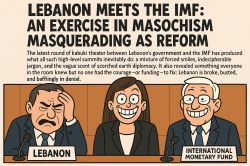
Lebanon Meets the IMF: An Exercise in Masochism

The latest round of kabuki theater between Lebanon’s government and the IMF has produced what all such high-level summits inevitably do: a mixture of forced smiles, indecipherable jargon, and the vague scent of scorched-earth diplomacy. It also revealed something everyone in the room knew but no one had the courage—or funding—to fix: Lebanon ...