- Home
- Middle East
- Netanyahu Draws Red Line on Gaza Postwar Plan
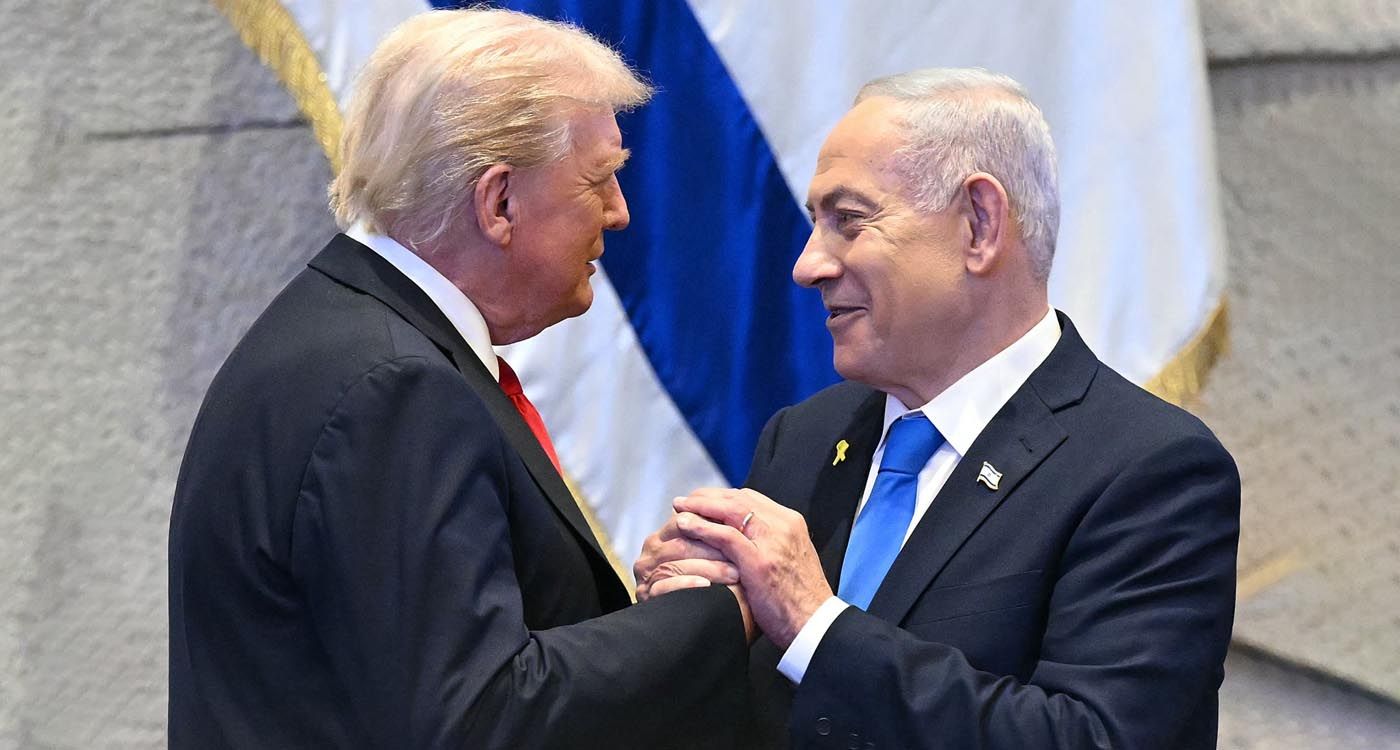
U.S. President Donald Trump holds hands and talks with Israeli Prime Minister Benjamin Netanyahu at the Israeli Parliament, the Knesset, in Jerusalem on October 13, 2025. ©Saul Loeb/POOL/AFP
Prime Minister Benjamin Netanyahu pledged Monday that Turkish and Qatari forces would not set foot in Gaza, days after the White House announced that officials from the countries would sit on a key committee set to oversee the Strip’s postwar management.
Speaking during a parliamentary session in Jerusalem, Netanyahu acknowledged a “certain argument” with the United States over Gaza’s future, as pressure mounts at home over Israel’s role in shaping the emerging international plan.
“Turkish soldiers and Qatari soldiers will not be in the Strip,” Netanyahu told lawmakers, drawing a clear distinction between diplomatic participation and military presence. “They will not have authority, and they will not have influence.”
The U.S. Announcement
The remarks came days after the White House confirmed that senior officials from Turkey and Qatar would sit on the Gaza Executive Board, a key committee created under U.S. President Donald Trump’s initiative to oversee Gaza’s postwar governance and reconstruction.
While the board’s mandate is supervisory rather than operational, its composition immediately raised alarms in Israel, where both Ankara and Doha are viewed as hostile actors due to their past political engagement with Hamas.
Reportedly, Netanyahu was not fully briefed ahead of the U.S. announcement, a claim that has fueled accusations that Israel was sidelined in decisions directly affecting its security. Israeli officials insist that while Turkey has expressed interest in contributing to a multinational security force, Qatar has not pursued any military role, with sources noting that its armed forces are not structured for such deployments.
Shifting the Message, Not the Policy
Prior to Washington’s announcement, Netanyahu’s office had repeatedly stated that Israel would not permit Turkey or Qatar to gain any foothold in Gaza after the war. Following the U.S. move, the prime minister narrowed his public opposition, focusing specifically on preventing foreign troops from entering the territory rather than rejecting diplomatic involvement outright.
The recalibration reflects the tightrope Netanyahu is walking as he seeks to preserve strategic coordination with Washington while projecting firmness to a domestic audience increasingly skeptical of foreign involvement in Gaza’s future.
“We argue with our allies when necessary,” Netanyahu said, insisting that disagreements with Washington do not undermine the relationship. “On Israel’s essential interests, we clarify positions, and we reach understandings.”
Hamas, Security, and the Threat of a Return to War
Netanyahu used the debate to reaffirm Israel’s core objectives for Gaza’s next phase, declaring that Hamas would be disarmed and the territory demilitarized, a cornerstone of Israel’s stated war aims since October 2023.
“Phase two is simple,” he said. “Hamas will be disarmed, and Gaza will be demilitarized. These goals will be achieved, either the easy way or the hard way.”
He also pledged to recover the body of the last Israeli hostage believed to be held in Gaza.
Opposition: ‘Trump Acted Over Your Head’
The Knesset session quickly escalated into a broader political confrontation, as opposition leaders accused Netanyahu of mismanaging both the war and Israel’s relations with its closest ally.
Opposition leader Yair Lapid said the U.S. decision to include Turkey and Qatar in Gaza oversight structures demonstrated that Washington had acted “over Israel’s head.”
“Either you secretly agreed to this, or the American president doesn’t care what you think,” Lapid said, warning that the emerging framework could drag Israel back into another costly war in Gaza under worse conditions than before.
The former defense minister echoed the criticism, accusing Netanyahu of empowering extremist partners within his coalition and questioning his leadership credentials as elections approach later this year.
As Washington presses ahead with an international framework and Israel draws red lines over who can operate on the ground, the question remains whether political coordination can keep pace with security realities or whether unresolved tensions will once again pull Gaza back into conflict.
Read more



Comments