- Home
- Middle East
- The Middle East Will Not Heal Until Iran Is Free
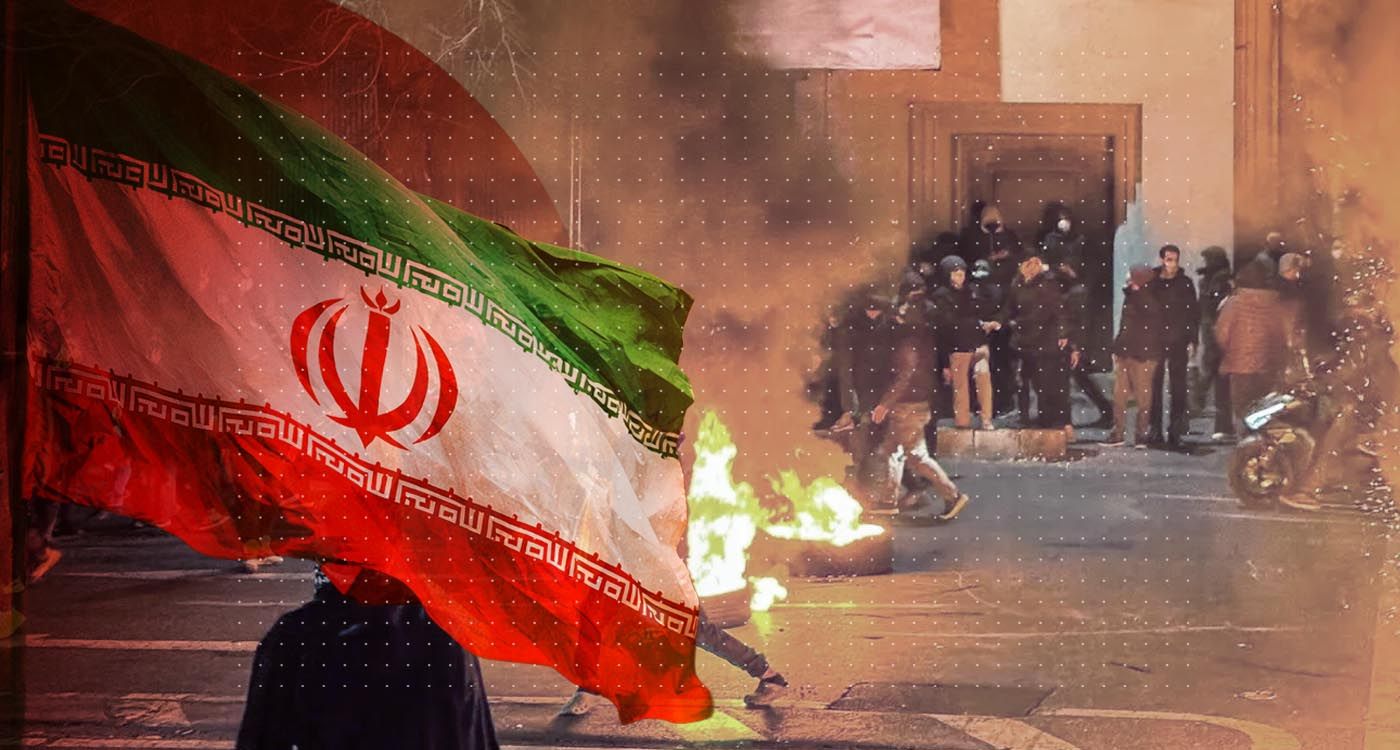
As Iranians flood the streets in mass demonstrations, demanding freedom at extraordinary personal risk, a fundamental truth has become impossible to ignore. The Middle East cannot heal until Iran is free from the Islamist regime that has poisoned the region for nearly half a century.
I came to this conclusion from lived experience, not ideology or theory. I was born in Syria and educated in Lebanon, two countries whose modern histories have been warped, brutalized, and ultimately broken by the Islamic Republic of Iran and the extremist ideology it exports.
Now, a painful irony is playing out before our eyes. In the West, we see unveiled Iranian women living freely and openly criticizing the regime they fled from without fear of arrest or execution. Yet from these same safe democracies, some voices now parrot the Islamic Republic’s propaganda, branding Iranian protesters as agents of Israel or the U.S. while accusing them of treason and betrayal.
It is understandable that some in the West question whether the Iranian people’s struggle is their concern. After decades of proxy wars, terror attacks, and moral exhaustion, many ask why intervene and risk further instability in the region for an uncertain future? The answer is strategic and historical.
When Iranians in the streets express goodwill toward the West, it does not mean they are traitors. They have compared propaganda with reality and chosen freedom over slogans. And when protesters defy imposed religious norms, it does not mean they are apostates. They have rejected the weaponization of religion by a regime that has brutalized, imprisoned, and killed its own citizens for dissent, sometimes for nothing more than a strand of uncovered hair.
Legitimacy cannot be judged from the comfort of freedom while others pay for resistance with their lives. Any regime that systematically kills its own people forfeits its moral claim to rule. The Islamic Revolution promised its people dignity, justice, and popular sovereignty but delivered none of these
Ayatollah Ruhollah Khomeini told Iranians they would no longer fear the government, yet fear became the organizing principle of the state he created after the 1979 revolution. The Islamic Republic purged allies, subjugated women, criminalized dissent, and hollowed out society. Its consolidation of power was a hostile takeover of an ancient civilization by a radical ideology.
From its inception, the Islamic Republic embraced permanent belligerence as a long-term strategy, declaring the U.S. the “Great Satan” and Israel the “Little Satan.” Tehran constructed a transnational empire of proxies designed to destabilize the Middle East, undermine global stability, and weaponize grievance as a tool of power.
The consequences are visible across the region I come from. Lebanon has been hollowed out and paralyzed, its sovereignty reduced to fiction. Syria was transformed into a killing field, with the Bashar al-Assad regime kept alive only through Iranian militias, foreign fighters, and mass slaughter. Meanwhile, Iraq became a proxy battlefield, while Yemen was dragged into ruin.
To finance this empire, Iran and its allies turned parts of the Middle East into a logistics corridor for organized crime. Drugs, produced at industrial scale in Assad-controlled Syria and trafficked through Hezbollah networks, flooded the region and Europe alike, poisoning entire generations. Iran cloaked these narco-financing networks under the ideologies of anti-imperialism and resistance.
Throughout all this devastation, Iran has repeatedly invoked the Palestinian cause as moral cover for its wrongdoing. The Islamic Republic never sought to liberate Palestinians, but to dominate the region and posture as the self-appointed vanguard of resistance, all while Iranians were crushed at home and Arabs were sacrificed abroad. Those who justify Tehran’s actions in the name of Gaza must face the uncomfortable truth that Iran is exporting war, not solidarity with the Palestinians.
In this context, international sanctions on Iran cannot be described as cruel. They are a rational response to a regime that openly calls for other nations’ destruction, pursues nuclear capability, exports terror, and represses its own people.
As a Syrian Arab who has come to recognize Israel not as the source of the Middle East’s suffering but as a potential partner in a post-extremist region, I say this clearly: once a tyrant loses its grip, new political and moral horizons open.
A Middle East without the Islamic Republic would not be perfect, but it would be more just, more stable, and finally open to futures that were once unthinkable. We have already seen that wherever fear recedes, conversations once thought impossible begin anew. When cooperation replaces coercion, a future can be imagined around livelihood rather than survival.
The fall of the Islamic Republic would remove the single most destabilizing force in the Middle East. It would allow Iranians to reclaim their country, Syrians to move forward with reconstruction, Lebanese to rebuild genuine sovereignty, and Israelis to face a region no longer organized around annihilation.
Rawan Osman is a Syrian-born, Lebanon-educated activist, political commentator and public speaker who advocates for Arab-Israeli normalization. A self-described Arab Zionist, she works with regional peace initiatives and founded an online platform after October 7 to challenge anti-Israel misinformation in the Arab world.
Read more

Comments