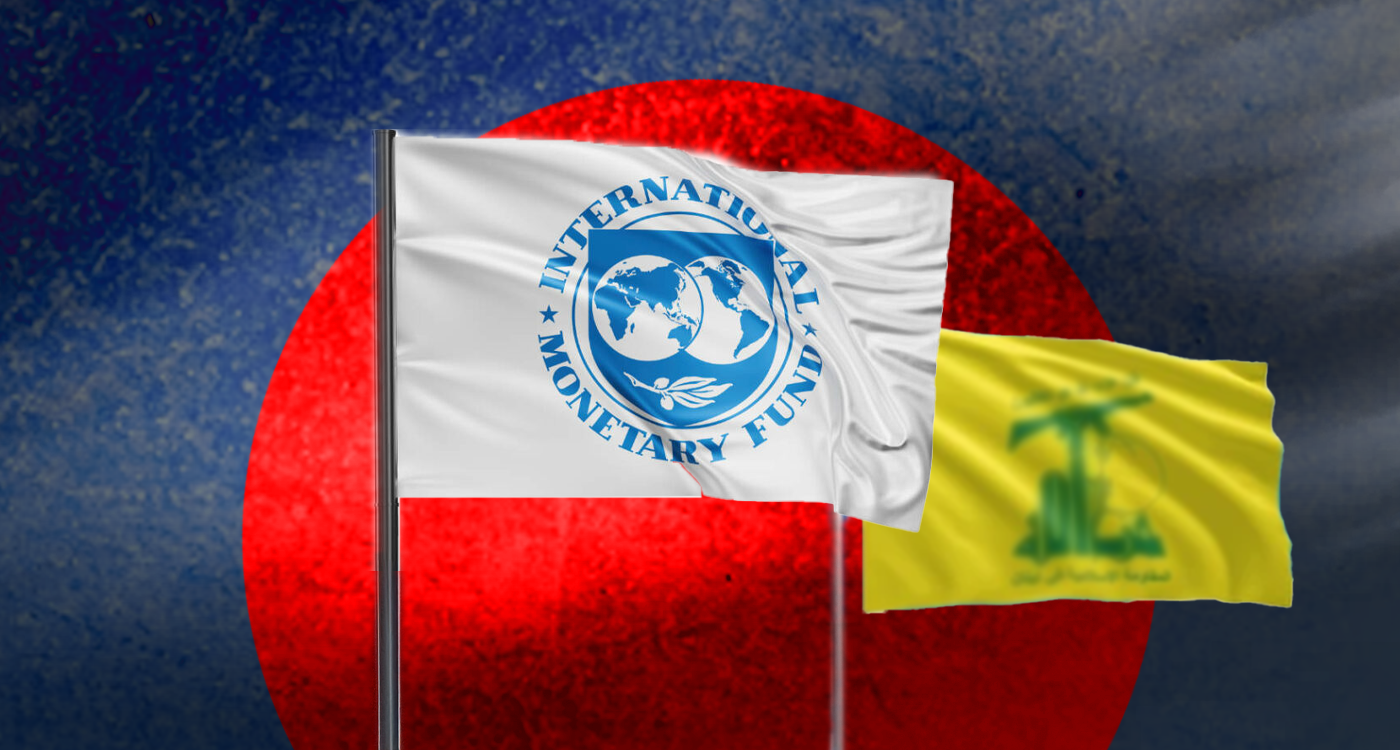
Critics say an IMF push to shift some of the Lebanese government’s bad debt onto the banking sector could provide Hezbollah financial oxygen.
The International Monetary Fund risks unintentionally reviving a war-weakened Hezbollah by insisting Lebanon push heavier losses onto the banking sector than critics say is necessary — a move they argue would entrench the cash economy that Iran’s terror-designated proxy thrives on.
At issue is how the IMF wants Lebanon’s government and central bank, Banque du Liban (BdL), to apportion the costs of a failed economy–the so-called financial restructuring needed to address an estimated $70 billion to $82 billion in losses.
Critics say an IMF push to shift some of the government’s bad debt onto a financial sector already reeling from default, economic collapse, capital controls and a paralyzing loss of trust in the banking system could exacerbate that confidence crisis. That could in turn give Hezbollah the financial oxygen it needs to rebuild, they argue. With the formal banking system frozen, the country is relying on an informal financial system that Tehran and its proxy have developed a mastery over through decades of illicit operations and money laundering.
War with Israel over the last two years has Hezbollah militarily, politically and financially weaker than it has been in decades, say many analysts. That has given authorities an unprecedented, though limited, opportunity to fundamentally and durably weaken the group’s power.
U.S. officials have urged Beirut in a series of high-level meetings in recent months to seize the chance by disarming Hezbollah and pushing through a slew of financial, economic and fiscal overhauls meant to right the capsized economy and protect against corruption and abuse by illicit actors, especially Hezbollah.
“We were very frank with the president, the prime minister and the other senior officials that there’s a window right now, particularly the window between now and the election,” U.S. Treasury Under Secretary for Terrorism and Financial Intelligence John Hurley said last month in Beirut. Hurley directly linked IMF-style reforms to cutting Hezbollah’s cash lifelines. He told reporters that Washington was pressing Lebanese officials to crack down on the flow of funding to Hezbollah ahead of next year’s parliamentary elections, and urged prosecutions tied to al-Qard al-Hassan, one of the quasi-banks Hezbollah uses to move funds outside the formal system.
In a separate visit, U.S. officials told Lebanese leaders that tightening controls on dirty money was as crucial as disarming Hezbollah, saying that weak financial system oversight has long allowed the group to maintain power and operate a parallel state.
In the wake of the war, Iran and Hezbollah have scrambled to consolidate the group’s remaining political and financial assets in the country. Tehran has sent its Lebanon-based proxy more than $1 billion over the last year—largely through exchange houses embedded in the cash economy–and U.S. intelligence analysts expect a surge in reliance on global illicit operations.
Meanwhile, Lebanon has made significant progress in some areas, including passing a bank-secrecy law meant to bring transparency to an opaque financial system that has allowed Hezbollah and other corrupt actors to flourish. Beirut also approved a bank restructuring law that creates procedures for resolving failed banks and establishes a commission to reorganize the sector.
The government has deferred one of the stickiest, but important issues, however: loss-sharing, or how the financial gap between assets and liabilities is divided between the state, BdL, banks and depositors.
While there is widespread acknowledgement of the need for the banking sector to bear some of the losses, of particular concern is an IMF proposal for the government to forgo repayment to the BdL of a $16.5 billion debt it owes to the central bank. The problem is that the BdL has earmarked that repayment for bank depositors, says Lebanese financial analyst and venture capitalist Samara Azzi.
“If the Lebanese government failed to honor its obligations and commercial banks and depositors were left to pick up the losses of its $16.5 billion debt, the commercial banking sector would almost certainly collapse,” said Azzi.
“The IMF’s approach is dangerous not only because it ensures the crippling of the formal banking sector, but also because it reinforces Lebanon’s cash economy—a shadow financial system now largely controlled by the so-called ‘Shia duo,’ Amal and Hezbollah,” she said.
By requiring depositors to bear a greater share of the government’s burden–especially without accountability for systemic corruption–critics say the IMF could foster depositor distrust, entrenching the cash economy and providing Hezbollah and its masters in Tehran critical time to rebuild war coffers, rearm its fighters and buy back power in parliament in the May elections.
If the state avoids repaying debt to Banque du Liban, “you’re going to have banks that go bankrupt,” said Hagar Chemali, a former U.S. Treasury official and a senior fellow at the Atlantic Council. “You continue to undermine trust in the banks…and then the cash economy is going to stay very alive and is going to thrive only further,” she said.
The IMF has publicly acknowledged the risks, including bank failures and an entrenched cash economy fueling illicit finance. But the Fund’s regional director, Jihad Azour, said the IMF’s proposed economic overhauls and financial restructuring would address the confidence crisis.
“Addressing the trust issue is by dealing with the key issues: One, debt sustainability, two, the sustainability of the financial sector, which will bring confidence back,” Azour said at the IMF meetings in October. “By bringing confidence back and by reactivating the banking system, you will see a gradual shift from a cash economy to a more formal economy,” he said.
The IMF is also wary of using state assets that some critics, including Chemali–suggest could be tapped to cover the government’s debts to BdL. The fund said, for example, that proposals to create a Deposit Recovery Fund — financed by public assets and aimed at repaying medium and large-scale depositors — could deplete resources needed for economic rehabilitation and social protection. It also risks “moral hazard,” the IMF said, by shielding politically connected actors from the consequences of their own decisions. Instead, public resources should remain focused on restoring debt sustainability, the IMF said, a source of future economic returns that reduces the Fund’s exposure to Lebanon potentially defaulting on its bailout loan. Because of what it says is a risk that state assets would benefit a “relatively small group of depositors (and likely politically connected)” the fund says it supports only limited state support—to strengthen the central bank’s capital position after reforming BdL’s governance.
But if Beirut and the IMF cannot figure out a compromise soon, analysts warn the delay could hand Hezbollah a financial lifeline by default.
Seeing a small window of opportunity, the U.S. is pressuring the government to deliver on some of its demands to crack down on Hezbollah, many of which align with the IMF’s requirements, according to the U.S.-based Institute for the Study of War.
“Hezbollah would likely use any delay in the Lebanese government’s implementation of the U.S. demands to reconstitute some of its capabilities,” the think tank said.

Comments