- Home
- Middle East
- Syria Army Takes Territory East of Aleppo After Kurdish Forces Withdraw
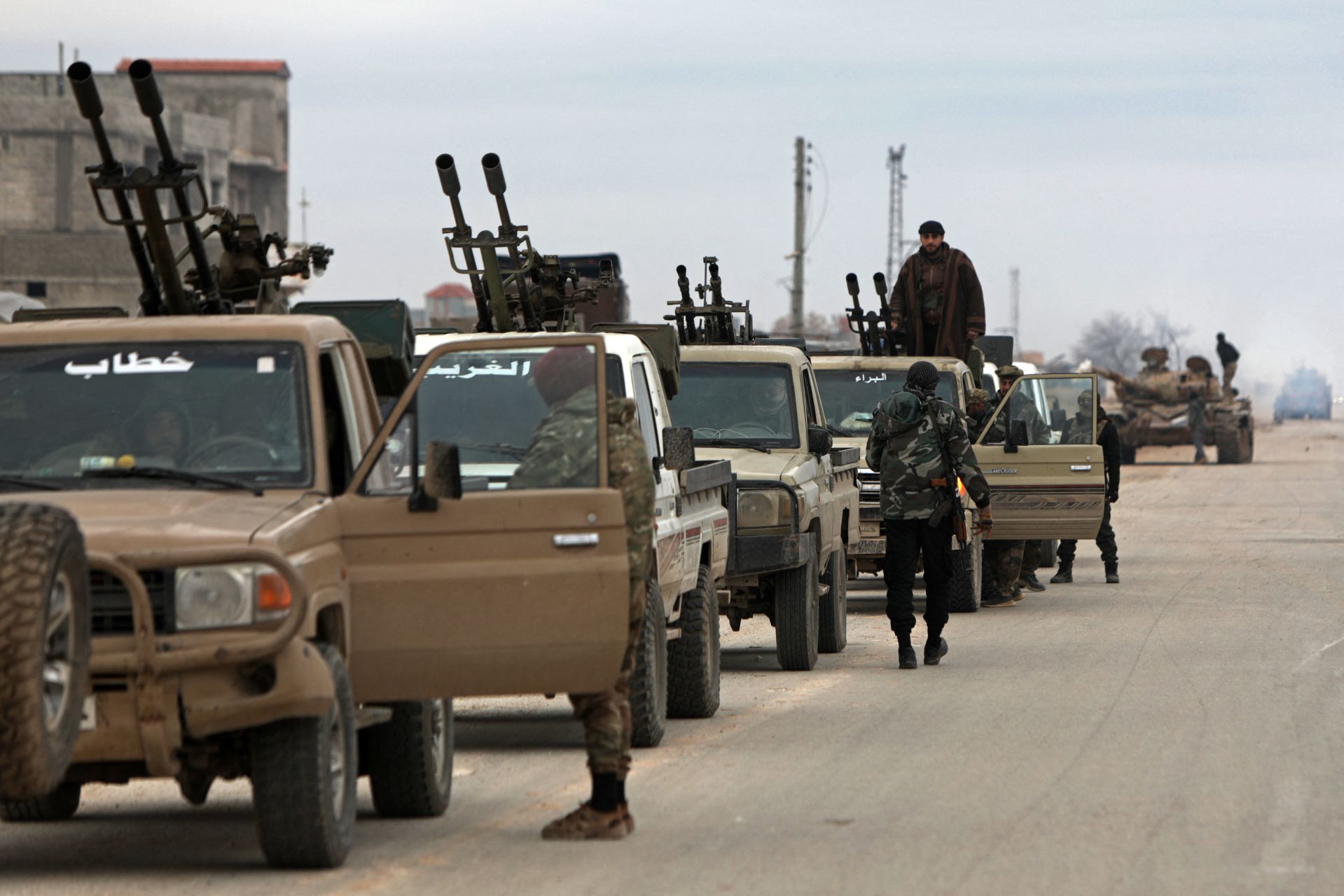
Syrian army soldiers, accompanied by their armored vehicles, gather ahead of entering the city of Deir Hafer on January 17, 2026. ©Bark Alkasem / AFP
Syria's army said Saturday that its forces had taken control of swathes of the region east of Aleppo city after Kurdish forces agreed to withdraw following recent clashes.
The advance comes a day after President Ahmed al-Sharaa issued a decree declaring Kurdish a "national language" and granting the minority official recognition in an apparent goodwill gesture, though the Kurds said it fell short of their aspirations.
The United States for years has supported the Kurds but also backs Syria's new authorities, and US envoy Tom Barrack was in Erbil on Saturday to meet with Mazloum Abdi, head of the Kurdish-led Syrian Democratic Forces (SDF), a source in the presidency of Iraq's autonomous Kurdistan region told AFP.
An AFP correspondent in Deir Hafer, some 50 kilometres (30 miles) east of Aleppo city, saw several SDF fighters leaving the town and a large number of residents who had fled the area returning, under a heavy presence of soldiers and security forces.
Abdi on Friday committed to redeploying his forces east of the Euphrates River following "calls from friendly countries and mediators".
In statements to state television, Syria's army said it had taken control of "34 villages and towns" east of Aleppo, including the key towns of Deir Hafer and Maskana, as well as a military airport.
But it accused the SDF of violating the agreement and targeting an army patrol near Maskana, "killing two soldiers".
It also said it had secured the exit of "more than 200 SDF organisation fighters and their weapons".
- Presidential decree -
The SDF, meanwhile, accused Damascus of violating the agreement, saying the army entered the towns of Deir Hafer and Maskana "before our fighters had fully withdrawn, creating a highly dangerous situation".
Syria's army had deployed reinforcements near Deir Hafer after driving Kurdish forces out of Aleppo city following deadly clashes last week.
It had told the SDF to evacuate the area between Deir Hafer and the Euphrates, around 30 kilometres further east, as well as towards the south.
Syria's Islamist-led government is seeking to extend its authority across the country following the ousting of longtime leader Bashar al-Assad in late 2024.
Progress on implementing a March deal to integrate the Kurds' de facto autonomous administration and forces into the state has stalled amid differences between the two sides, including the Kurds' demand for decentralised rule.
Sharaa's announcement on Friday was the first formal recognition of Kurdish rights since Syria's independence in 1946.
The decree stated that Kurds are "an essential and integral part" of Syria, where they have suffered decades of marginalisation and oppression under former rulers.
It made Kurdish a "national language" that can be taught in public schools in areas where the community is heavily present, and granted nationality to all Kurds, 20 percent of whom had been stripped of it under a controversial 1962 census.
- 'Drive a wedge' -
The Kurdish administration in Syria's north and northeast said the decree was "a first step, however it does not satisfy the aspirations and hopes of the Syrian people".
"Rights are not protected by temporary decrees, but... through permanent constitutions that express the will of the people and all components" of society, it said in a statement.
In Qamishli, the main Kurdish city in the country's northeast, Shebal Ali, 35, also said the decree fell short.
"We want constitutional recognition of the Kurdish people's rights," he told AFP, noting the constitution must be "drafted by all Syrians".
Nanar Hawach, senior Syria analyst at the International Crisis Group, told AFP that the decree "offers cultural concessions while consolidating military control".
"It does not address the northeast's calls for self-governance," he told AFP, adding that "Sharaa is comfortable granting cultural rights, but draws the line at power-sharing".
He said Damascus appeared to be seeking "to drive a wedge between Kurdish civilians and the armed forces that have governed them for a decade".
Kurdish forces control swathes of Syria's oil-rich north and northeast, much of which they captured during the country's civil war and the fight against the Islamic State group over the past decade.
AFP
Read more
Comments