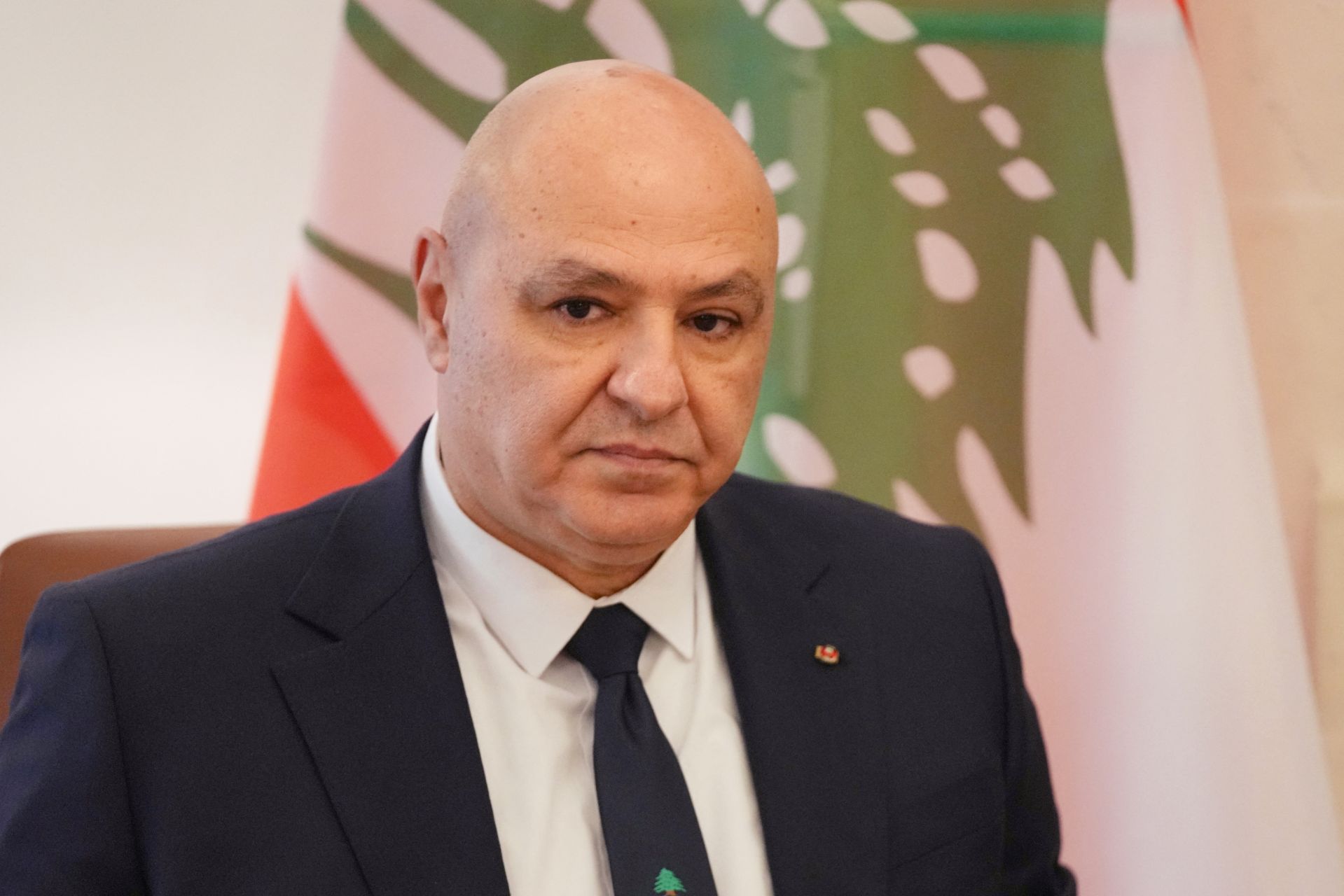
Lebanese President Joseph Aoun delivered one of his clearest and most direct statements to date on Hezbollah’s arms on Sunday, urging the militia to “act rationally” and fully integrate into the Lebanese state.
In a televised interview marking the second anniversary of his election, Aoun laid out his vision for restoring state authority and rebuilding Lebanese institutions, placing the issue of weapons outside state control at the center of his message.
Speaking to Télé Liban, President Aoun called for a decisive shift toward full state responsibility for security and defense. He warned that weapons outside state control have become a burden on both the country and the group’s own support base.
“Either inside the state, or outside it”
Aoun addressed Hezbollah directly, saying the time had come for the party to make a clear choice.
“It is time for the other party to act rationally and place its hand in the hand of the state,” he said. “Either you are truly within the state, or you are outside it.”
He stressed that his remarks were not intended as provocation, but as an appeal to logic and national responsibility, insisting that Lebanon cannot function with parallel centers of military decision-making.
According to Aoun, the protection of Lebanese territory and citizens is no longer a task that should fall on any single group. “Defending the people and the land is the responsibility of the state,” he said, adding that no segment of Lebanese society should continue to shoulder this burden alone.
From historical necessity to political liability
The president acknowledged the historical context in which Hezbollah’s weapons emerged, noting that they were established during a period when the Lebanese state and army were absent or unable to perform their duties.
However, he argued that those circumstances have fundamentally changed.
“That phase has ended,” Aoun said, emphasizing that the Lebanese army and state institutions are now present and capable across the country. While Hezbollah’s arms were once seen by some as a means to deter Israel and secure withdrawal, Aoun said they have since “become a burden on their environment and on Lebanon as a whole.”
He urged a realistic assessment of current regional and international conditions, suggesting that clinging to past justifications risks undermining Lebanon’s stability and future.
A sovereign decision, not foreign pressure
The Lebanese president was careful to frame the issue of weapons as a domestic sovereign matter, rejecting the notion that calls to limit arms to the state stem from foreign demands.
He said the principle of exclusive state control over weapons is rooted in Lebanon’s constitutional framework and explicitly stated in the Taif Agreement. This, he stressed, applies to all armed groups without exception, including Palestinian factions operating in the south.
“There must be one state, one decision, and one weapon,” Aoun said, adding that this is the only viable foundation for a functioning state.
Security realities and the Israeli threat
Addressing the ongoing security situation, Aoun acknowledged continued Israeli airstrikes on southern Lebanon but downplayed the likelihood of a broader conflict, a position that contrasts with narratives used to justify maintaining independent armed capabilities.
“Israeli attacks are ongoing, but the specter of a large-scale war or a ground invasion is much more distant today,” he said.
He added that halting Israeli violations and achieving a full withdrawal would help accelerate efforts to place all weapons under state authority. Aoun noted that the Lebanese army has expanded its control over areas south of the Litani River, stressing that the priority is preventing the region from becoming a launchpad for military operations.
The army as the cornerstone of state authority
Aoun acknowledged that the Lebanese army faces challenges, particularly in terms of funding and equipment, but insisted these obstacles are solvable with political will and international support.
What matters most, he said, is the principle: a state that monopolizes both the use of force and strategic decision-making. Building military capacity, he argued, is a gradual process, but building a state while weapons remain fragmented is impossible.
Regional relations and internal decision-making
In a broader political message, Aoun reaffirmed that Lebanon’s key decisions must be made domestically.
“Lebanon’s interest requires that decisions be made inside the country, not outside it,” he said, calling on all political forces to cooperate with state institutions and prioritize national interest over regional alignments.
He also addressed reports regarding Syrian officers allegedly present in Lebanon following the collapse of Bashar al-Assad’s regime, denying that senior figures had been identified and confirming coordination with Syrian authorities on the matter.
A call for national consensus
Aoun concluded by urging Lebanese political forces to rally around a single national project centered on institutions, the rule of law, and national sovereignty.
His message, delivered at a moment of heightened regional tension and internal economic strain, signals an attempt to reassert state authority at a moment when Lebanon faces a choice between continued paralysis driven by armed non-state actors and a return to institutional governance under a single national decision-making framework.
Comments