- 07
- Jan.
- 2026

The United States dealt Iran and its proxy Hezbollah a strategic blow over the weekend by seizing key ally, Venezuela’s strongman Nicolás Maduro.
While the dominant narrative of the complex military strike has focused on its framing as a counternarcotics operation and aggressive energy politics, coverage has largely missed a critical strategic intent: weakening the power that Maduro’s authoritarian allies established throughout Latin America.
The removal of Maduro and the U.S. move to control Venezuela for the foreseeable future deliver a decisive setback to Iran, potentially stripping Tehran of its most important ally in the Western Hemisphere and Hezbollah of its most consequential regional partner.
The U.S. action—described by officials as a law-enforcement operation supported by the military—represents the clearest operational expression of the so-called convergence doctrine to date by the Trump administration. U.S. officials portray Maduro not merely as a corrupt dictator, but as the pivotal figure overseeing a sprawling network connecting transnational crime, state sponsorship, and proxy warfare, leveraging Latin America’s cartels as strategic weapons deployed by America’s adversaries in a global contest for power.
While U.S. officials and analysts say Russia and China had operationalized Venezuela’s systemically corrupt government to advance their interests in the region, Tehran has been widely recognized as securing some of the strongest strategic gains through a decades-long campaign to embed throughout the structures of power in Latin America, especially through its Lebanon-based proxy, Hezbollah.
Venezuela was Iran’s strategic capstone, with Tehran having infiltrated the corrupt government to the highest levels, according to current and former U.S. officials and two decades of criminal prosecutions.
“Under the now deposed dictator Maduro, Venezuela was increasingly hosting foreign adversaries in our region and acquiring weapons that could threaten U.S. interests and lives,” Trump said Saturday in announcing the action. “They used those weapons last night, potentially with the cartels operating along our border,” he added.
Secretary of State Mark Rubio cited Iran in particular at the same press conference, and just four days prior to the strike, the U.S. Treasury Department sanctioned 10 individuals and entities it said were responsible for the banned transfer of Iran’s Mohajer-series military drone technology to Venezuela.

U.S. Department of the Treasury
Iran has used Hezbollah for decades as a tool for asymmetrical warfare against the U.S. and its allies, capitalizing on the group’s leveraging of expansive criminal networks throughout the global Lebanese/Syrian diaspora, say current and former U.S. officials. Hezbollah operatives commandeer transnational criminal organizations operating within the diaspora to raise funds for its weapons, terror attacks, and a host of other operations, those officials say. Coordinating and contracting with corrupt politicians and other criminal organizations, including Latin American cartels, Hezbollah runs multi-billion-dollar illicit operations, including narcotrafficking, money-laundering and arms-dealing.
U.S. officials have grown increasingly concerned in recent years that these networks have become operational platforms threatening the U.S. and its interests in the Western Hemisphere, fundamentally changing the geopolitical calculus, including the extent to which Washington is willing to challenge Tehran in direct warfare. Because of their size, scope and operational capabilities, those networks can efficiently and covertly move men, money, arms and intelligence into strike positions, current and former Western intelligence and security officials say. And they help create the trade and finance networks that allow Iran and other authoritarian regimes opposed to U.S.-led liberal democratic principles to sidestep one of the West’s most potent tools of diplomatic coercion: sanctions and export controls.
According to court filings and extensive interviews with current and former U.S. national security and law enforcement officials, Maduro and a host of other top current and former Venezuelan officials and their associates have coordinated with Hezbollah operatives and Latin American drug cartels not just for personal enrichment, but to challenge U.S. power and threaten democratic interests more broadly.
The indictments against Maduro and his alleged co-conspirators, for example, include Diosdado Cabello Rondón, the country’s interior minister and a member of the Venezuelan armed forces, Tareck El Aissami, the former vice president and oil minister, and Hugo Carvajal, the former intelligence chief who pled guilty last year to narcoterrorism, weapons and drug trafficking charges. Authorities say those men conspired with Adel El Zabayar, a former member of the Venezuelan National Assembly of Syrian descent, to traffic cocaine and weapons in coordination with several terror-designated groups, including Hezbollah. Prosecutors said Cabello Rondón and El Aissami were also involved in directing El Zabayar to recruit members of Hezbollah and Hamas to train at clandestine training camps located in Venezuela “for the purpose of helping to plan and organize attacks against the United States.”
El Aissami, while head of Venezuela's passport and naturalization agency, was instrumental in furnishing passports and citizenship documents to Hezbollah operatives as well as a large number of people from Lebanon, Syria, and Iran, according to Marshall Billingslea, a former U.S. Treasury assistant secretary for terrorist financing in the first Trump administration now a senior fellow at the Hudson Institute think tank in Washington. Regime officials provided Venezuelan passports to more than 10,400 people from those three countries between 2010 and 2019, he said, though Venezuelan opposition members suggest that number now totals more than 20,000.
According to Al-Hadath, the Saudi Arabian state-owned television news channel, approximately 400 Hezbollah commanders were ordered to leave Lebanon for South America, including Venezuela, to avoid a Lebanese government campaign to dismantle the group.
The strike is of strategic importance not only in helping Washington dismantle Iranian and proxy networks that give Tehran an operational platform to attack and undermine the U.S. and allied interests in the Western Hemisphere, but also because it provides an opportunity to throttle critical financing operations, especially for Hezbollah.
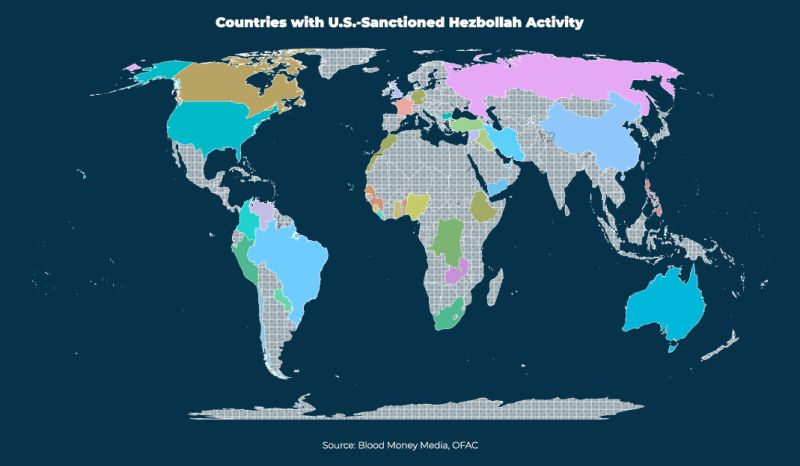
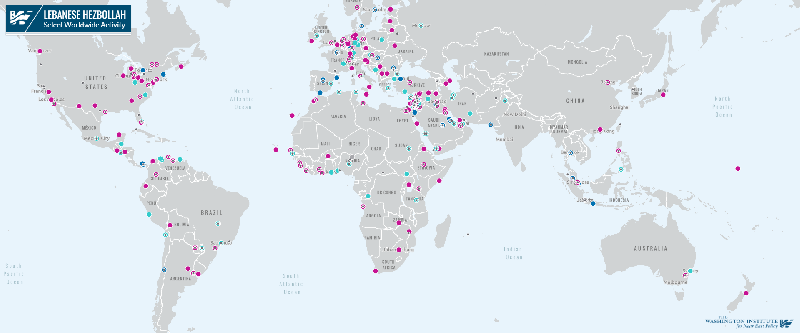
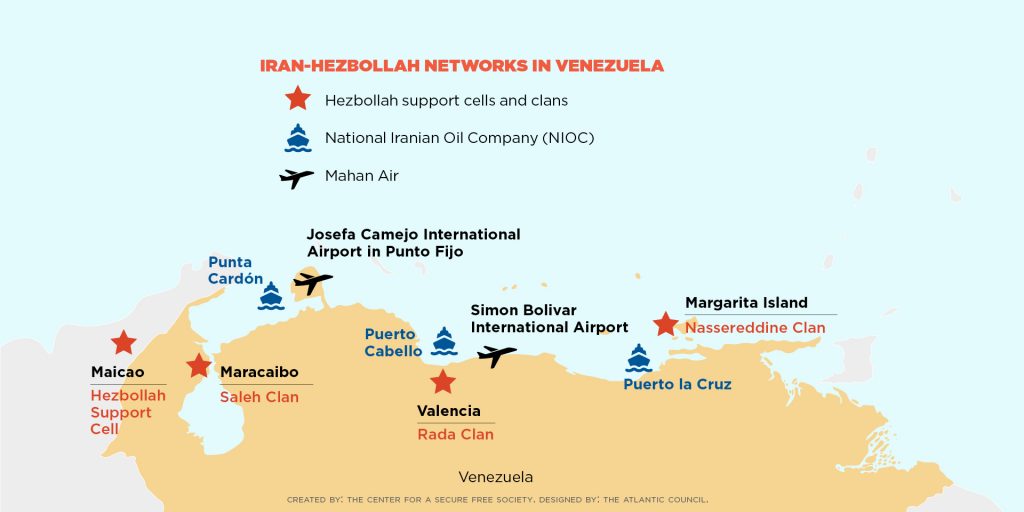
Hezbollah Mapped 1 by Ian Talley
The timing of the action, therefore, is also strategic in that it hits Hezbollah funding efforts just as U.S. lawmakers, military analysts, and former top U.S. security officials say the terror-designated group is expected to rely on its expansive global operations to help it reconstitute in the wake of its war with Israel. It comes as Lebanon’s new government revitalizes efforts to strip the Iranian proxy of its financial, military and political power within the country.
“If we target Hezbollah's financing, we can deny them the opportunity to rebuild,” Senator Sheldon Whitehouse, the Rhode Island Democrat who co-chairs the Senate Caucus on International Narcotics Control, said at a recent hearing on the group’s Latin American operations.
U.S. military analysts say Israel’s war with Hezbollah, combined with efforts by Lebanon’s new government, may prompt the group to turn towards insurgent tactics and increase its reliance on their global illicit networks for funding and survival.
U.S. Department of the Treasury
Hezbollah’s setbacks “could prompt the organization to leverage its global networks more aggressively,” wrote Marzia Giambertoni, a security policy analyst for the RAND, a U.S.-based think tank whose research is funded in part by the U.S. government. “Given the intense operational pressure that Hezbollah faces in Lebanon and Syria, the organization might view its Latin American networks as providing strategic depth for retaliation, potentially seeing the region as a theater in which it can retaliate while minimizing the risk of direct escalation in the Levant,” Giambertoni said in a policy paper published in March 2025.
The importance to the Trump administration of countering Iran and Hezbollah’s operational capabilities in Venezuela is also underscored by the U.S. military’s efforts to blockade oil tankers operating off the nation’s coast in recent weeks. Of the three vessels the U.S. has publicly said that it has either seized or pursued, two of them were linked by the U.S. Treasury Department to funding operations for Hezbollah and Iran’s terror-designated special foreign-ops military unit, the Islamic Revolutionary Guard Corps. The Bella 1, for example, was sanctioned in 2024 for carrying cargo on behalf of Concepto Screen SAL Off-Shore, which Treasury said was used by two senior Hezbollah officials, Muhammad Qasim al-Bazzal and Muhammad Qasir, who was killed by Israeli forces in 2024.
U.S. officials, including Trump, have also said the Venezuela strike should be read as a shot over the bows to any other nation threatening U.S. interests, a warning to other nations in Latin America and beyond that may be providing a safe haven for Hezbollah and Iranian interests.
Hezbollah-linked operations have been publicly documented in the majority of the 20 mainland Latin American countries, a circumstance fostered in part, analysts say, because only a fraction of those have officially declared Hezbollah a terrorist group.
Hezbollah’s expansive operations through its global criminal diaspora ties mimic the evolving sophisticated diversificationof Iran’s decentralized financial systems. By diversifying assets and funding systems, Hezbollah insulates its operations against disruption by the U.S. and its allies. That diversification strategy is applied not only geographically, but also in the broad spectrum of channels the group uses to move illicit money and goods around the world.
“Hezbollah has just hopped from free trade zone to free trade zone throughout the world, but especially in Latin America,” Matthew Levitt, a senior fellow at the Washington Institute for Near East Policy, said at the recent Senate caucus hearing on Hezbollah’s drug trafficking operations in the region.
“You tell me a free trade zone, I'll tell you at least one Hezbollah case there,” said Levitt.
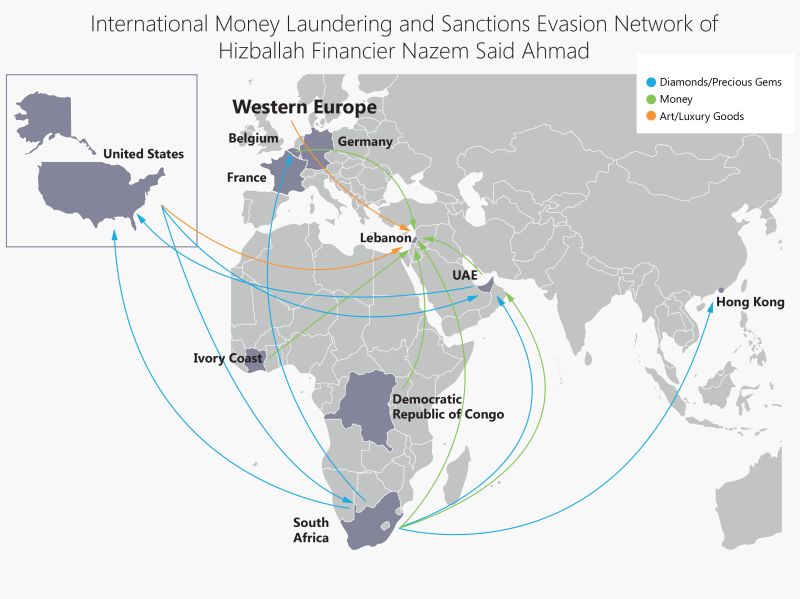
How Hezbollah’s Diversified Global Financial Operations Provide the Terror Group Longevity
Take, for example, Lebanon-based Syrian money exchanger Tawfiq Muhammad Sa’id al-Law. U.S. and Israeli intelligence say he provided Hezbollah digital wallets to receive funds from the terror-designated IRGC Qud Force’s sale of Iranian commodities around the world, conducted crypto transactions for a Syrian company that facilitated fuel and weapon shipments for the former Assad regime, and conducted cryptocurrency transfers for Qasir and al-Bazzal. One of al-Law’s digital wallet addresses was later traced by intelligence analysts to crypto operations in Argentina, where authorities arrested four people for an alleged Hezbollah digital-currency financing operation.
Or Samer Akil Rada, the brother of one of the men allegedly responsible for orchestrating the 1994 AMIA bombing. The U.S. Treasury Department in 2023 sanctioned Rada’s Venezuela-based BCI Technologies C.A. that reportedly specializes in cryptocurrency transactions and worked with the Maduro regime. The U.S. linked Rada to drug trafficking and money-laundering activities throughout Latin America and said his son, Mahdy Akil Helbawi, used a Colombia-based company that shipped charcoal to Lebanon as part of the clan’s Hezbollah financing operations.
That clan’s longevity is a testament to the fact that many of Hezbollah’s global operational networks remain operational despite detection by intelligence and law enforcement agencies, according to current and former U.S. officials.
Another example is represented by the massive U.S. Drug Enforcement Administration’s Project Cassandra, a multi-year investigation launched in the late 2000s to map and dismantle Hezbollah’s global criminal and financial networks. That probe uncovered how Hezbollah, working with Iranian intelligence and the IRGC, had embedded itself in the international cocaine trade and built a sophisticated money-laundering system spanning Latin America, West Africa, Europe, and the United States. Investigators documented how drug proceeds—often from Colombian and Venezuelan suppliers—were laundered through used-car dealerships, trade-based schemes, and front companies, generating hundreds of millions of dollars for Hezbollah’s operations in Lebanon. But out of around 300 used-car dealerships identified by law enforcement, only 10% were targeted by prosecutors, and many remained operational years later.
Hezbollah’s international operations have since continued to grow, according to the anti-terror-finance watchdog, the Financial Action Task Force. In June, FATF noted in a special report on arms financing that Hezbollah’s extensive smuggling operations, global network of licit and illicit businesses, and penetration of financial institutions and foreign exchange houses in countries around the world allow it to be a dominant global money-laundering agent that represents a significant proliferation threat.

Comments