- Home
- Middle East
- Netanyahu: Trump Meeting to Focus on Gaza, Lebanon, and Syria
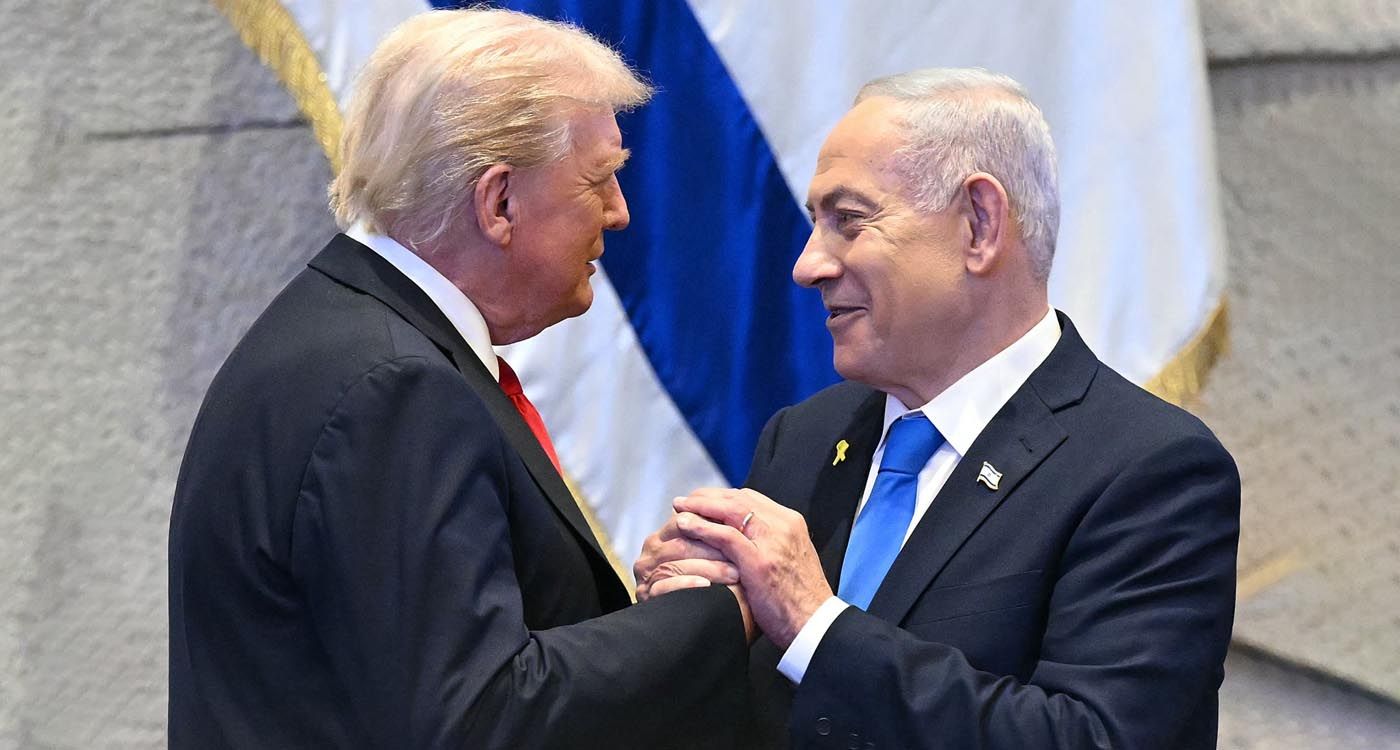
U.S. President Donald Trump holds hands and talks with Israeli Prime Minister Benjamin Netanyahu at the Israeli Parliament, the Knesset, in Jerusalem on October 13, 2025. ©Saul Loeb/POOL/AFP
Israeli Prime Minister Benjamin Netanyahu is set to arrive in Washington on Monday, December 29, for talks with President Donald Trump, focusing on regional developments, including the Trump administration’s plan for Gaza and rising tensions with Lebanon.
On Sunday, Netanyahu said he expects the second phase of the Gaza ceasefire plan to be launched and intends to discuss “peace opportunities” in the Middle East with Trump, as Israel and Hamas continue to accuse each other of violating the truce.
“They will discuss the next steps and the various phases, as well as the international stabilization force planned under the ceasefire agreement,” said Israeli Prime Minister Netanyahu’s spokesperson, Shosh Bedrosian, at a press conference on Monday. “We have nearly completed the first phase of the ceasefire plan,” she added.
The Israeli government says the second phase of the Gaza truce can only begin after Hamas returns the body of the last Israeli hostage still held in Gaza. The second phase is expected to involve disarming Hamas and demilitarizing Gaza, Bedrosian added.
According to the Times of Israel, the United States will use Netanyahu’s visit to officially announce the creation of the Board of Peace, an international body responsible for Gaza’s administration. Chaired by Trump, the organization will establish an interim executive committee to appoint Palestinian technocrats to manage the territory.
Israel’s Channel 12 reports that Netanyahu will spend eight days in the country and visit Trump’s Mar-a-Lago estate in Florida, marking the fifth meeting between the two leaders since Trump’s reelection in January.
Israel Seeks U.S. Backing on Lebanon
Netanyahu is also expected to discuss Lebanon, as the deadline for Lebanese authorities to disarm Hezbollah approaches. According to the Israeli media outlet Yedioth Ahronoth, Israel doubts that Lebanon will meet the deadline and has warned that it “will not wait indefinitely.”
In recent days, the Israeli press has suggested the possibility of a new military campaign against Hezbollah, but any major operation would require Washington’s approval. While Donald Trump aims to avoid an escalation that could undermine his “peace process” in the region, he continues to pressure the Lebanese government to accelerate Hezbollah’s disarmament while curbing Israeli ambitions.
Meanwhile, the Lebanese authorities appear to be seeking a reprieve, notably by appointing a civilian, former Lebanese ambassador to the United States Simon Karam, to lead the Lebanese delegation to the ceasefire supervision mechanism meetings. The appointment has been welcomed by both the United States and Israel, though Israel considers it inadequate.
Since the ceasefire, Israel has carried out multiple strikes on what it says are Hezbollah targets and aims to maintain military pressure on Beirut.
In this context, Lebanese President Joseph Aoun visited Oman on December 9 and 10, where both sides called for an immediate halt to Israeli attacks on Lebanon and expressed support for international efforts to prevent further escalation.
Moving Toward a Security Agreement with Syria?
The Syrian issue is also expected to be discussed during the meeting, as Donald Trump seeks to encourage Israel to reach a security agreement with Syria’s interim president, Ahmed al-Sharaa. However, Israel is insisting on the demilitarization of southern Syria and wants guarantees to maintain a humanitarian corridor to the southern Sweida province.
Syria, for its part, is demanding Israel withdraw from five positions in southern Syria, a request Israel refuses to accept until its own conditions are secured. Tel Aviv also remains determined to maintain a presence on the Syrian side of Mount Hermon, a key strategic asset.
Any pressure President Donald Trump may exert on his Israeli ally could prove decisive in determining the outcome.
Read more


Comments