- 12
- Dec.
- 2025

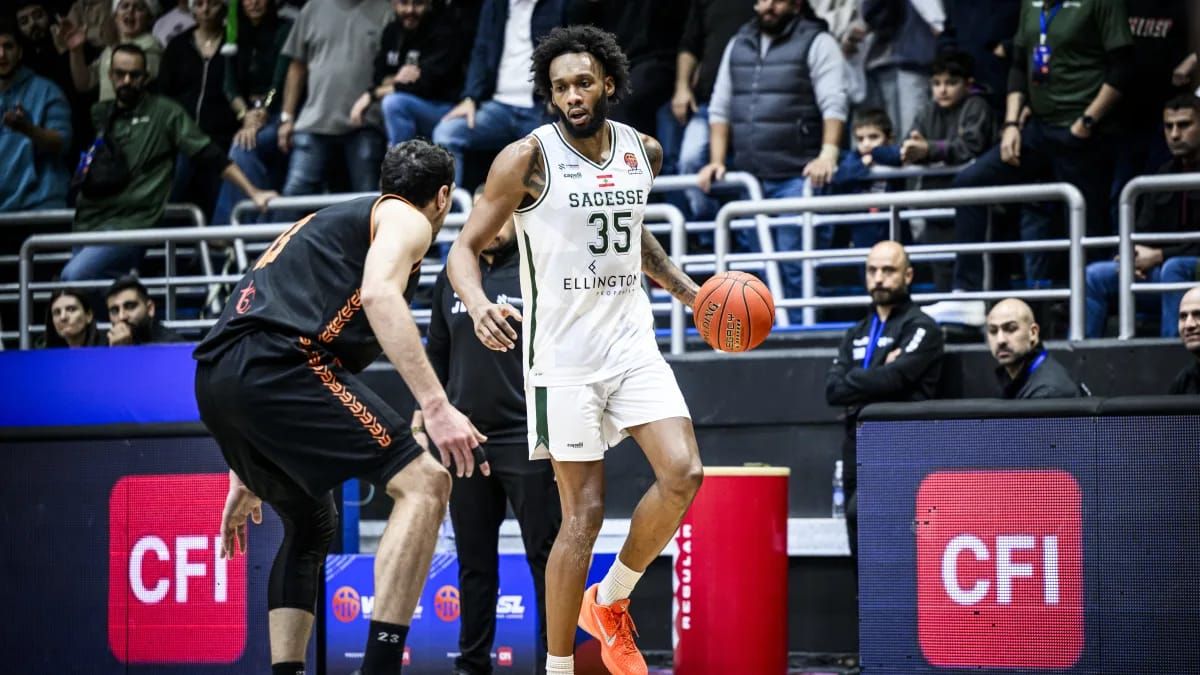
Within just 24 hours, the two Lebanese giants competing in WASL – West Asia lived completely opposite fortunes: Riyadi saw its long undefeated run collapse in Astana, while Sagesse finally got on the board with a hard-fought win over Al Wahda in Ghazir. More than simple results, these are two powerful signals sent across Lebanese basketball.
One scene almost says it all: in Astana, the “Yellow Castle” leaves the court with heads down, its 15-game group-stage winning streak gone in the Kazakh cold. In Ghazir, a few hours later, the “Green Castle” finally erupts in joy after a nightmarish start to the campaign. With Riyadi no longer as frightening and La Sagesse beginning to believe again, the balance of Lebanese dominance in the region may not yet be shifting—but it is certainly trembling.
Astana Cools Down the Yellow Castle
Riyadi arrived at the Saryarka Velodrome carrying a heavy label: reigning champion, chasing a four-peat, 15 straight group-stage wins since 2022–23, and the status of the team everyone wants to beat. Astana didn’t just accept the challenge—the Kazakh club broke the lock wide open (86–72), using red-hot perimeter shooting to freeze the Yellow-and-White in the final quarter.
Driven by a dominant Robert Pan (21 points, 9 rebounds), backed by Chsherbak and Zhigulin (13 points each) and by Day (11 points, 10 assists), the home side ignited from beyond the arc at the start of the fourth. In a handful of possessions, the lead stretched to +18 (76–58), as the crowd roared.
Riyadi reacted, of course. Maurice Kemp (23 points, 7 rebounds) tried to spark the comeback, Ivan Buva (14 points, 9 rebounds) and Perrin Buford (10 points, 7 assists, 3 steals) pushed as well, cutting the deficit to –7 (77–70) with 1:11 left. But Astana didn’t crack. A free throw from Jusikevicius, a bucket from Zhigulin, and the final points from Day and Pan sealed the door shut.
Beyond the score, the impression left is striking: for a long time, challenging Riyadi—even away—felt like certain suicide. But Astana played freely, without fear, even taking the luxury of calmly managing the money-time. The aura of invincibility is fading. And it’s impossible to ignore the major absence: Wael Arakji.
Without its star point guard, Riyadi loses part of its aggression, creativity, and ability to kill games in clutch moments. The roster remains stacked, the collective solid, and Riyadi is still the team to beat in WASL and in the Lebanese league. But opponents no longer tremble as before: Gorgan, Astana, and others now know that with intensity, outside shooting, and a clear game plan, the champion can be shaken.
Sagesse Finally Breaks Free in Ghazir
A completely different scene unfolded in Ghazir. After a nightmare 0–3 start in WASL, Sagesse could no longer afford mistakes when hosting Al Wahda. The verdict: a precious 75–69 victory—more importantly, a collective feeling of relief for a club deeply affected by its disastrous opening.
Paris Bass played the role of X-factor—if not outright leader—with 23 points, 9 rebounds, and a fiery third quarter in which he scored 15 by himself. He ignited the 10–0 run that turned a small lead into a real gap (53–42), giving the “Green Nation” its first real moment of control in this WASL campaign.
Behind him, the new recruits delivered exactly what they were brought in for. Kevin Murphy (19 points, 7 rebounds), formerly of Kazma and… Riyadi, reminded everyone of his quality, while Walter Hodge (14 points) perfectly managed the tempo late in the game when the lead, once at +13, began to shrink.
With a well-used eight-man core from coach Joe Ghattas, Ali Haidar (9 points, 11 rebounds) and Gerard Hadidian (8 points) brought the energy and subtle plays that don’t always appear in the stats but change games: hard screens, contested rebounds, defensive help, communication.
On the other side, Al Wahda didn’t give up. James Justice Jr (19 points, 7 rebounds, 7 assists) and Falando Jones (15 points) led the charge, supported by the rebounding work of Prince Orizu (8 points, 10 rebounds) and Bilal Atli (6 points, 11 rebounds). Despite dominating the boards (53–42), the Syrians remained behind.
For Sagesse, the essential lies elsewhere: finally escaping the label of the only winless WASL team, breathing again, restoring confidence in a rebuilt squad, and sending a message to its fans. In Ghazir, this first win feels almost like the beginning of a new season.
A Message for the Rest of the Season
After these two nights, the conclusion is simple: Riyadi and Sagesse show the same record trends (2–1 for the Beirutis before Astana, 1–3 for the Greens in WASL), but two completely different dynamics.
Riyadi, defeated for the first time in a group stage since January 2023, must deal with a double challenge: preserve its status as the benchmark while rediscovering the extra spark and fear it used to impose. The absence of Wael Arakji explains part of the dip, but not all. Defensively, the champion left far too much freedom to an Astana team that went all in.
Sagesse, on the other hand, must now prove that this win is not a one-off. The schedule will be unforgiving: back to the Lebanese league, then a perilous trip to Tehran to face Gorgan on January 7. They must build on this reference game, finally establish a clear identity, and avoid falling back into early-season mistakes.
In the end, Lebanese basketball remains firmly present on the WASL map: Riyadi still aims for the title, Sagesse refuses to be a bystander. But the reality on the court is clear: the champion no longer inspires the same fear, and the “little brother” is starting to lift its head.
Comments