- 09
- Dec.
- 2025
LAU Medical Center – Rizk Hospital: A Century of Medicine at the Heart of Beirut
Read : 7 minute(s) A A A
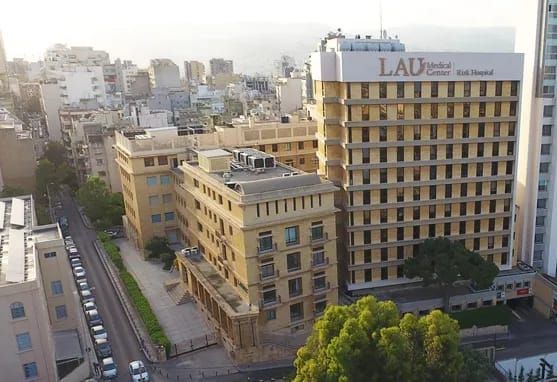
From the small twelve bed clinic founded by Dr. Toufic Rizk in 1925 to the major university hospital now affiliated with LAU, the Achrafieh institution has weathered a century of wars, crises, and reforms. Rooted in a family legacy and driven by an academic mission, its history also reflects the broader journey of Lebanese medicine.
A hundred years ago, a young surgeon just back from Paris put up a sign near the Nasra tram stop in Sodeco: “Dr. Toufic Rizk Clinic.” Twelve beds, three nurses, one passion: practicing modern surgery in a Lebanon still finding its way. At the time, no one could have imagined that this small beginning would grow into a full hospital in 1957 and, by 2009, become the main teaching hospital of the Lebanese American University (LAU).
Alongside his wife Olga Toubia, Dr. Toufic Rizk also laid the foundations of a genuine medical dynasty. Their sons Assaad, Pierre and Paul all became physicians, while their daughter Mona assisted her father in the operating room. The small clinic that opened in Sodeco in 1925 soon moved to Ras el Nabeh, and in 1934 to Basta al Fawka. With each relocation the same pattern emerged: more patients, greater trust, and a stronger place in the medical landscape of Beirut.
A century later, the LAU Medical Center Rizk Hospital marks its centennial with a clear objective. It seeks to remain a neighborhood hospital firmly rooted at the heart of the capital while fully embracing its academic mission and serving as a national point of reference.
From a Family Clinic to a Resilient Institution
The story of the LAU Medical Center Rizk Hospital officially begins in 1925, when Dr. Toufic Ibrahim Rizk (1892–1983) founded his private clinic in Sodeco. From Ras el Nabeh to Basta al Fawka, the clinic moved with the rhythm of a growing city, practicing patient-centered medicine.
Early on, Dr. Rizk relied on the moral and financial support of his brother Abdallah Bey Rizk, who helped transform the “Dr. Rizk Clinic” into a true institution. In the 1950s, Italian nuns from the Order of the Franciscan Sisters of the Sacred Heart of Mary and later the Choueirite Sisters of Khenshara joined the team and contributed to its daily operations.
The hospital experienced a major architectural milestone in 1957 when the “Dr. Rizk Clinic” moved to Achrafieh with the inauguration of Building A. A visit from President Camille Chamoun then established the hospital as one of the country’s leading medical institutions.
In the 1960s and 1970s, Dr. Assaad Rizk, returning from Paris where he had specialized in urology, took over the hospital’s leadership alongside his father. His brothers would join him later. Surrounded by a strong team, Dr. Assaad Rizk modernized the facility, introduced new techniques, and opened one of the country’s first hemodialysis centers. In 1971, the “Rizk Foundation” launched Lebanon’s first non-profit blood bank, which later became the “Lebanese Blood Transfusion Center”, an initiative that further cemented the hospital’s role in public health.
The war years followed. Even as Beirut was torn apart, the hospital stayed fully operational. In 1985, the team launched a kidney transplant program. During the 1990s, the “Dr. Rizk Clinic” achieved several firsts in interventional cardiology, including the placement of coronary stents, TIPS procedures, and percutaneous mitral valve dilation. In 1990, the hospital joined the National Organ Donation Program, reinforcing its pioneering role in transplantation in Lebanon.
In 1991, the third generation officially stepped in when Sami Rizk, son of Dr. Assaad Rizk, joined the leadership. Under his guidance, the hospital continued to expand. Buildings C and D were added, increasing both capacity and specialties, while the early 2000s marked the achievement of new milestones.
In 2002, the “Dr. Rizk Clinic” opened Lebanon’s first hospital helipad and became the country’s first medical center to receive ISO 9001 certification, cementing a culture of quality. In 2008, an adjacent building was acquired to prepare for future expansion.
“What impresses me most about the hospital’s journey,” says Sami Rizk, Executive Director of the LAU Medical Center Rizk Hospital, “is its ability to keep growing even in the toughest times. Building a facility in the 1980s on the Green Line, or establishing a helipad during a period of instability, is not just a construction project: it is an act of faith in the country.”
Stepping into the University Era
A major turning point came in 2009. On June 30, Dr. Assaad Rizk transferred ownership of the hospital to the Lebanese American University. Under the guidance of LAU President Dr. Joseph Jabbra and Dr. Assaad Rizk, the facility became the University Medical Center – Rizk Hospital before taking its current name: LAU Medical Center – Rizk Hospital.
“This change in ownership did not erase the Rizk DNA,” explains Dr. Georges Ghanem, former Medical Director. “It extended it within a university framework. We inherited a hospital built by surgeons committed to modern medical practice. With LAU, we added the academic dimension: training, research, protocols, and international standards.”
Today, the LAU Medical Center – Rizk Hospital is the primary university hospital of LAU, serving the faculties of medicine, nursing, and pharmacy.
Over the years, several projects have accompanied this development: A Comprehensive Stroke Center opened in 2018 for the treatment of cerebrovascular accidents, along with ongoing advances in interventional cardiology and structural procedures, building on initiatives launched in the 1990s.
“To be a teaching hospital means accepting that every patient who walks through our doors challenges us twice. First, because they come seeking care; second, because they give us the opportunity to train a generation of doctors who will have to do better than we did,” adds Dr. Ghanem.
Keeping the Course in a Crisis-Stricken System
In Lebanon, where the healthcare system has been battered by economic collapse, the medical exodus, and the decline of purchasing power, running a hospital of this caliber is a daily challenge.
“We operate in a country going through one of the worst economic crises in its recent history,” acknowledges Sami Rizk. “Costs are soaring, salaries cannot keep up, and patients are caught between their needs and their means. Our responsibility is twofold: to remain sustainable as an institution while continuing to provide care that is accessible, humane, and quality-driven.”
This structural crisis was compounded by successive shocks: TheBeirut port explosion in August 2020, the COVID-19 pandemic, and then the Israeli war of 2024. The LAU Medical Center – Rizk Hospital has remained open, continued its investments, and expanded its services.
In 2020, while the city was still recovering from its wounds, the LAU Mobile Clinics were launched, reaching out to the country’s most remote regions. That same year, the hospital restructured and expanded its ENT Department. In 2022, the country’s first hybrid operating room went into service, combining advanced imaging with surgery in a single space.
By 2025, as Lebanon slowly emerged from another period of tension and crisis, the hospital launched an Executive Health Prevention Program (EHPP) and completed the renovation of Building D.
“The greatest risk is not only economic, it is moral. A hospital is not a building, it is a community: caregivers, patients, families, and students. If you break that trust, you lose everything. That is why we place great emphasis on transparency, patient information, ethics committees, and ongoing training,” emphasizes Dr. Ghanem.
A Century On, the Same Promise
As the institution celebrates its 100th anniversary, it would be easy to settle for a simple album of memories. The leadership team prefers to see it as a starting point.
“The centennial is not a medal to hang on the wall,” says Sami Rizk. “It is an obligation to live up to those who built before us and to those who will come after. When a patient walks through our doors, they are not seeking a foundation date; they are seeking a promise to be cared for with competence, respect, and dignity.”
For a century, the LAU Medical Center – Rizk Hospital has been defined by more than its buildings, certifications, or accreditations. It is both a community partner, a training ground for generations of doctors, nurses, and health professionals, and an essential resource in times of need.
“If Dr. Toufic were to walk into the hospital today,” imagines Dr. Georges Ghanem, “I think he would be surprised by the scanners, the robots, and the screens. But he would recognize one thing: the gaze of caregivers at the patients’ bedsides. That is true continuity.”
At its core, this is where it all matters: in the invisible thread that links the twelve-bed clinic of 1925 to the university hospital of 2025. In Achrafieh, the buildings have evolved, the equipment has become more sophisticated, the signs have been replaced, yet the promise remains the same: to continue caring with compassion.
A century later, the LAU Medical Center – Rizk Hospital is more than a hospital. It is a story of loyalty to a family, to a university, and above all, to a certain vision of medicine in Lebanon.
Comments