- Home
- Middle East
- Mediators Qatar and Egypt Call for Next Steps in Gaza Truce
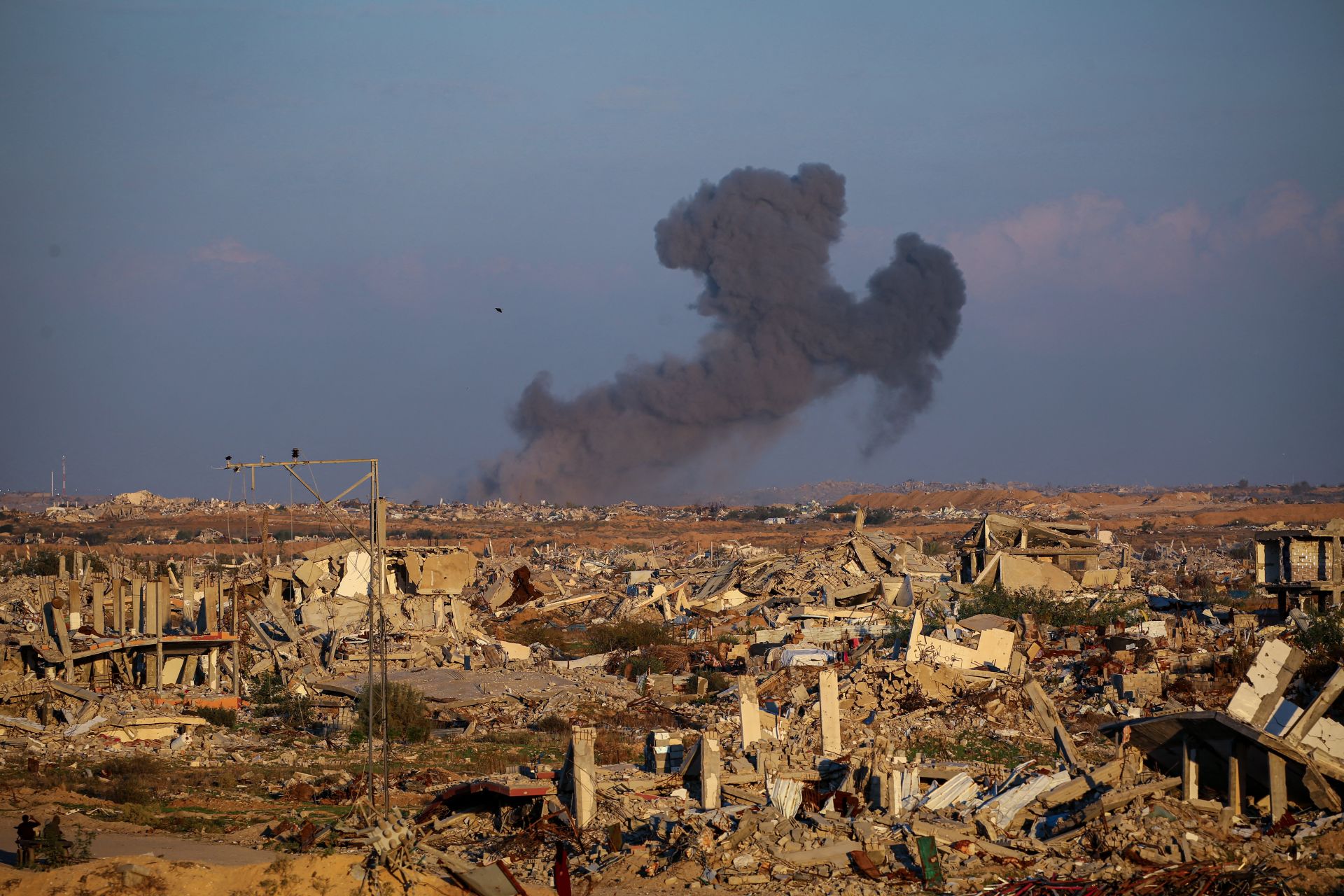
This picture taken from the Nuseirat camp for displaced Palestinians shows destroyed buildings and smoke billowing in the distance following Israeli strikes east of Gaza City on December 2, 2025. ©Eyad Baba / AFP
Qatar and Egypt, guarantors of the Gaza ceasefire, called on Saturday for the withdrawal of Israeli troops and the deployment of an international stabilization force as the necessary next steps in fully implementing the fragile agreement.
The measures were spelt out in the US- and UN-backed peace plan that has largely halted fighting, though the warring parties have yet to agree on how to move forward from the deal's first phase.
Its initial steps saw Israeli troops pull back behind a so-called "yellow line" within Gaza's borders, while Palestinian militant group Hamas released the living hostages it still held and handed over the remains of all but one of the deceased.
"Now we are at the critical moment... A ceasefire cannot be completed unless there is a full withdrawal of the Israeli forces and there is stability back in Gaza," Qatari premier Sheikh Mohammed bin Abdulrahman Al Thani told the Doha Forum, an annual diplomatic conference.
Qatar, alongside Egypt and the United States, helped secure the long-elusive truce, which remains delicate as Israel and Hamas accuse each other of breaching its terms.
Key sticking points have also emerged over the implementation of the second phase, which has yet to begin, including the question of Hamas's disarmament.
Under the plan endorsed by the UN in November, Israel is to withdraw from its positions, Gaza is to be administered by a transitional governing body known as the "Board of Peace," and an international stabilization force is to be deployed.
"We need to deploy this force as soon as possible on the ground because one party, which is Israel, is every day violating the ceasefire," Egypt's Foreign Minister Badr Abdelatty said at the Doha Forum.
The Egyptian foreign ministry said in a statement that Abdelatty and Sheikh Mohammed met on Saturday, with both stressing "the importance of continuing efforts to implement" the peace agreement.
Arab and Muslim nations, however, have been hesitant to participate in the new force, which could end up fighting Palestinian militants.
Meanwhile, US President Donald Trump would theoretically chair the "Board of Peace," while the identities of the other members have yet to be announced.
'Main Objective'
Turkey's Foreign Minister Hakan Fidan told the forum that talks on the stabilization force were ongoing, with critical questions remaining as to its command structure and which countries would contribute.
But its first goal, Fidan said, "should be to separate Palestinians from the Israelis."
Abdelatty seconded the idea, calling for the force to be deployed along "the yellow line in order to verify and to monitor" the truce.
There have been multiple deadly incidents of Israeli forces firing on Palestinians in the vicinity of the yellow line since the ceasefire went into effect.
Hamas is supposed to disarm under the 20-point plan first outlined by Trump, with members who decommission their weapons allowed to leave Gaza. The militant group has repeatedly rejected the proposition.
Turkey, which is also a guarantor of the truce, has indicated it wants to take part in the stabilization force, but its efforts are viewed unfavorably in Israel.
Fidan later said at the Doha Forum that the disarmament of Hamas should not be the main priority in Gaza.
"That cannot be the first thing to do in the process, the disarming. We need to put things in their proper order; we have to be realistic," he said.
He also urged the US to intervene with Israel's Prime Minister Benjamin Netanyahu to ensure the plan succeeds.
"If they don't intervene, I'm afraid there is a risk the plan can fail," Fidan said.
"The amount of daily violations of the ceasefire by the Israelis is indescribable at the moment and all indicators are showing that there is a huge risk of stopping the process," he added.
Rafah Crossing
Sheikh Mohammed said Qatar and the other truce guarantors were "getting together in order to force the way forward for the next phase" of the deal.
"And this next phase is just also temporary from our perspective," he said, calling for a "lasting solution that provides justice for both people."
The ceasefire plan calls for Gaza's Rafah crossing on the border with Egypt to be reopened to allow in aid.
Israel this week said it would open the checkpoint, but "exclusively for the exit of residents from the Gaza Strip to Egypt."
Egypt swiftly denied that it had agreed to such a move, insisting the crossing be opened both ways.
Israel's announcement drew expressions of concern from several Muslim-majority nations, who said they opposed "any attempts to expel the Palestinian people from their land."
Abdelatty insisted on Saturday that Rafah "is not going to be a gateway for displacement," but only an entry point for aid.
AFP
Comments